Practice Case | A Six-Year Practice in Physical Gold and Silver Allocation (Revised Edition)
English translation of the Chinese original (AI-assisted). Read the original in Chinese.
Practice No.: P-2019-001 Practice period: 2019 – present Status: Ongoing (structure completed, ratio adjustment not yet completed) Main costs: time, liquidity, and opportunity cost Current conclusion: the method is kept, for use only in specific circumstances
Part One: The Nature and Logic of the Practice
I. This Is Not Trading, but a Cross-Generational Decision
Beginning in 2019, I have been buying physical gold and physical silver continuously.
One thing needs to be made clear first: this was not a trading decision, but an asset-allocation practice.
At the time, there was no "best entry point," nor a "clear target price." The decision was not driven by any particular market move, but by two judgments that had gradually formed over the previous several years:
- The monetary system carries long-term instability
- In the face of macro uncertainty, individuals need some assets that do not depend on the credit system
These judgments did not come from a single sudden event. They formed gradually through long-term reading, observation, and repeated comparison with historical cycles.
II. How It Was Done: Low Frequency, Spread Out, Physical
1. Continuous rather than concentrated
Since 2019, I have bought in stages and in batches. The purpose was not to "average down the cost," but to:
- Avoid emotion-driven decisions
- Avoid relying too heavily on any single point in time
- Make time itself part of the practice
2. Physical rather than financial derivatives
I chose physical gold and silver rather than ETFs, futures, or paper instruments. This means:
- Lower liquidity
- Higher storage and management costs
- Less convenience
But in return, I get:
- No dependence on third-party credit
- No participation in the leveraged system
- No passive exposure to short-term volatility
This was a deliberate choice to give up convenience in exchange for structural certainty.
III. Interim Result: Six Years, About 100% Nominal Growth
By the end of 2025, this practice had grown by about 100% overall in nominal price terms.
It should be stressed that:
- This result was not the goal
- It is not proof that the method is correct
- Still less is it any kind of promise that it can be replicated
It is simply a result that has already happened, and so it is recorded truthfully.
Part Two: Why I Did Not Sell — Designing a Cross-Generational Inheritance
IV. Not Selling Was a Deliberate Choice
One thing about this holding needs to be clear:
I did not refrain from selling because I believed the price would keep rising.
At the level of asset allocation, I could certainly have sold part of it after it doubled and locked in the gains. But I did not.
The reason is simple: from the very beginning, this practice was not only for myself.
V. A Structural Change in How I Understand Assets
Around the age of forty, my understanding of the word "assets" changed structurally.
Before, I understood:
- Price
- Opportunity
- Return
Now, I understand:
- Time
- Cycles
- Saving
This change did not happen suddenly; it was the result of years of observation and practice. Although "it is never too late to start" holds true logically, looking back from today, I hope the next generation will not have to wait until this age to realize these things.
VI. Why Gold and Silver Rather Than Other Assets?
As a vehicle for inheritance, I chose gold and silver rather than real estate or stocks, based on these structural considerations:
1. Recognizable across generations. Real estate depends on the legal and economic environment of a particular place; stocks depend on the survival of a particular company. The physical properties of gold and silver can be recognized in any era and do not depend on the continuation of any particular system.
2. Rules that can be passed on. The gold-silver ratio is a rule that can be stated clearly and carried out across generations. The location value of real estate and the fundamental analysis of stocks are hard to reduce to simple, executable rules for the next generation.
3. No active management. Real estate needs maintenance; stocks need you to follow the company. Gold and silver need almost no active management at the physical level, which lowers the burden of carrying things out during inheritance.
This does not mean gold and silver are the "best choice." Under the constraints of an inheritance scenario, they are relatively suitable vehicles.
VII. This Holding Is Itself a Verification Sample
I did not choose gold and silver because they are "smarter," but because they are intuitive enough, long-term enough, and hard enough to "mess up."
Through this real holding process, I hope my child will one day be able to verify several things with his own eyes:
- Cycles exist
- Prices can swing dramatically, but time filters out the noise
- Saving is not a loser's choice, but preparation for uncertainty
- Some assets do not need frequent trading to do their job
I do not intend to "teach" these conclusions with words. The asset itself is the evidence.
VIII. Leaving the Judgment to the Next Generation
This is also why, at this stage, I have no plan to sell.
Not selling does not mean never touching it. In the future, I may make structural adjustments between gold and silver according to the gold-silver ratio. But the assets as a whole will continue to exist.
There is only one reason: I hope that one day, when my child truly begins to understand the word "asset," this practice will already be there—not as a story, but as a fact that can be examined.
Part Three: Execution Rules and Historical Verification
IX. Responsibility Statement (Before the Specific Rules)
What follows involves specific execution rules and historical backtesting, so the following must be made clear in advance:
- This setting is highly subjective and has no statistical guarantee
- Historical backtesting is not proof of future validity
- Everything here represents only the long-term choices I personally am willing to bear
- None of this is investment advice of any kind
X. My Adjustment Setting: 40 and 100 as Two Long-Term Anchors
For future adjustments, I did not choose a complicated model. I set myself only two numbers:
40 100
They are not forecasts. They are stable extreme anchors that I have seen again and again in roughly a hundred years of gold-silver ratio history.
📉 Long-term historical range of the gold-silver ratio (1915–2025). Source: MacroTrends
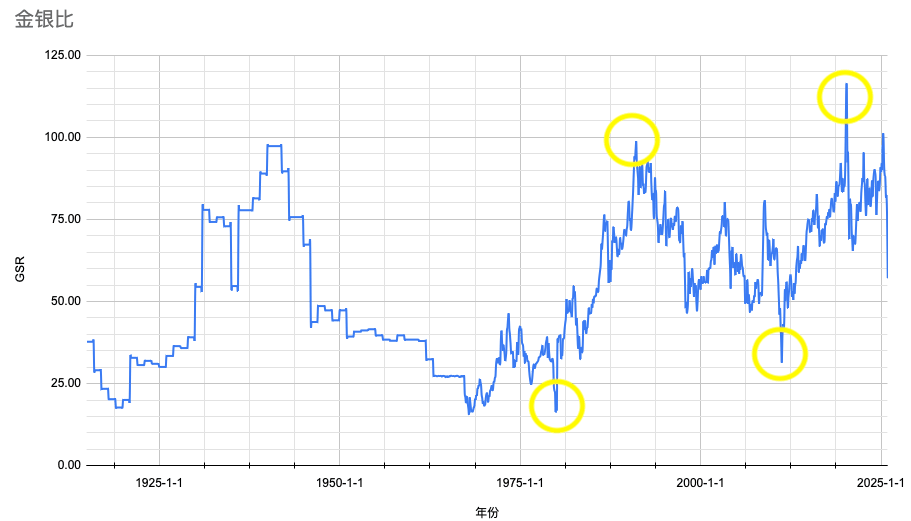
From the data of the past 65 years (the yellow marks in the chart are historical extremes):
- Around 1980: the gold-silver ratio fell to the 20–25 range, one of the lowest levels in history
- Around 1991: the gold-silver ratio broke above 100 for the first time, entering an extreme high
- Around 2011: the gold-silver ratio fell back to 30+, close to the historical low
- March 2020: the gold-silver ratio reached a historical extreme of 120+, an extreme imbalance under the pandemic shock
The two anchors I set for myself—40 and 100—are exactly the stable boundaries of these historical extremes:
- When the gold-silver ratio is ≤40, silver has become "cheap" enough relative to gold; consider exchanging silver for gold
- When the gold-silver ratio is ≥100, silver has become "expensive" enough relative to gold; consider exchanging gold for silver
I do not try to judge whether "this time will be the same." I accept only one fact: over a long enough time scale, extremes will appear.
XI. This Is Not a Forecast, but a Subjective Rule I Am Willing to Follow
I know one thing very clearly: no one can objectively derive the path of the gold-silver ratio over the next hundred years.
But I have still set myself a clear, executable, and inheritable subjective rule:
- When the gold-silver ratio is close to or well above 100: → gradually reduce gold and acquire silver
- When the gold-silver ratio is close to or well below 40: → gradually reduce silver and switch back to gold
Throughout the process:
- No new money is added
- No frequent trading
- Act only within extreme ranges
There is only one goal: without relying on forecasts and without adding principal, increase the quantity of physical metal held through changes in the ratio.
XII. Historical Verification: Three Exchanges of $100 Starting in 1969
The purpose of the backtest below is not to show how much this method can earn, but to use historical data to check one simple structural fact:
Over a long enough time scale, the extreme ranges of the gold-silver ratio (≤40 or ≥100) do indeed recur.
This fact is the only premise of the whole adjustment rule.
Assumptions:
- Starting point: 1969
- Initial capital: $100
- First purchase: silver
- Rule: exchange only when the gold-silver ratio is in the extreme ranges of ≤40 or ≥100
- Taxes, premiums, spreads, shipping, and other frictions are ignored
1969–2025 | Extreme gold-silver ratio exchanges (illustrative)
| Node | Year | Gold-silver ratio | Action | Change in holdings | Nominal value at the time |
|---|---|---|---|---|---|
| Start | 1969 | ≈23–25 | Buy silver | $100 → 55.9 oz silver | $100 |
| 1st exchange | 1980 | ≈38 (≤40) | Silver → gold | 55.9 oz silver → 1.46 oz gold | ≈$870 |
| 2nd exchange | 1991 | ≈100 (≥100) | Gold → silver | 1.46 oz gold → 144.8 oz silver | ≈$515 |
| 3rd exchange | 2011 | ≈31 (≤40) | Silver → gold | 144.8 oz silver → 4.61 oz gold | ≈$7,060 |
| Held to date | 2025 | ≈65 | No action | 4.61 oz gold | ≈$19,900 |
Notes:
- In 56 years, there were only 3 truly meaningful exchanges
- The fourth key point (the ratio above 120 in 2020) was a deliberate decision not to act—because my holdings were already in gold at the time, the rule required waiting for the ratio to fall below 40 before switching back to silver
XIII. A Direct Comparison with "No Exchanges" Over the Same Period
| Strategy | Bought in 1969 | Held in 2025 | Value in 2025 |
|---|---|---|---|
| Gold only | 2.44 oz gold | 2.44 oz gold | ≈$10,500 |
| Silver only | 55.9 oz silver | 55.9 oz silver | ≈$3,700 |
| Extreme-ratio exchanges | Silver → gold → silver → gold | 4.61 oz gold | ≈$19,900 |
Note that this comparison shows only the final result. During actual execution, the exchange strategy's value had fallen to about $515 in 1991, far below the value of simply holding gold over the same period.
This means whoever follows the strategy must be able to tolerate medium-term paper losses and stick to the rule even when prices move against their own judgment.
This is not about forecasting rises or falls. It is about growing the quantity held through repeated extreme deviations.
XIV. The Complete Chain of Logic I Hope My Child Will See
If one day these assets pass to the next generation, I hope they see not a single conclusion, but a clear chain of logic:
- Cycles exist over the long term
- Extremes recur
- People cannot predict the exact timing
- But rules can be set in advance for the extremes
- And one can be willing to follow them over the long term
This logic is more worth inheriting than any single "successful trade."
Conclusion
I have not figured out what the next hundred years will bring, but I have figured out the rules I am willing to follow for the next hundred years.
Whether this rule is right will not be judged by the present; time will give the result.
But whatever the outcome, the rule itself is already a complete logic I can pass on to the next generation.
That is why I am willing to put it into my "Practice Collection."
Some images in the original are not included in the web version.